Bubble Database Design: Best Practices for Scalability
The Foundation of Application Performance: Strategic Database Architecture
Database architecture represents the foundational infrastructure layer determining your Bubble application's long-term scalability, query performance, and maintenance complexity. A strategically designed data structure enables optimal search performance, intuitive workflow implementation, and seamless feature expansion. Conversely, suboptimal database design creates cascading performance degradation, exponentially complex workflows, and prohibitive technical debt that compounds with application growth.
Enterprise-grade Bubble applications serving hundreds of thousands of users maintain sub-second response times through meticulous database architecture. This comprehensive guide examines proven data modeling principles that enable sustainable application scaling.
🔧 Building a complex database? Get our Database Architecture Template or consult with our data modeling experts.
Core Database Design Principles for No-Code Architecture
Data Normalization: Eliminating Redundancy and Maintaining Integrity
Data normalization—the systematic elimination of redundant information storage—constitutes the primary principle of scalable database design. Rather than duplicating user information across multiple data types, implement relational structures that reference canonical data sources.
Implementation Example: In an e-commerce application, avoid storing customer name, email, and address fields directly on Order records. Instead, establish a relational connection between Orders and Users data types. This approach ensures:
- Data Consistency: User information updates propagate automatically across all related orders
- Storage Efficiency: Eliminate redundant data storage, reducing database size by 40-60%
- Query Performance: Simplified data structures enable more efficient search operations
- Maintenance Simplification: Single-source-of-truth architecture reduces update complexity
Strategic Data Type Architecture Planning
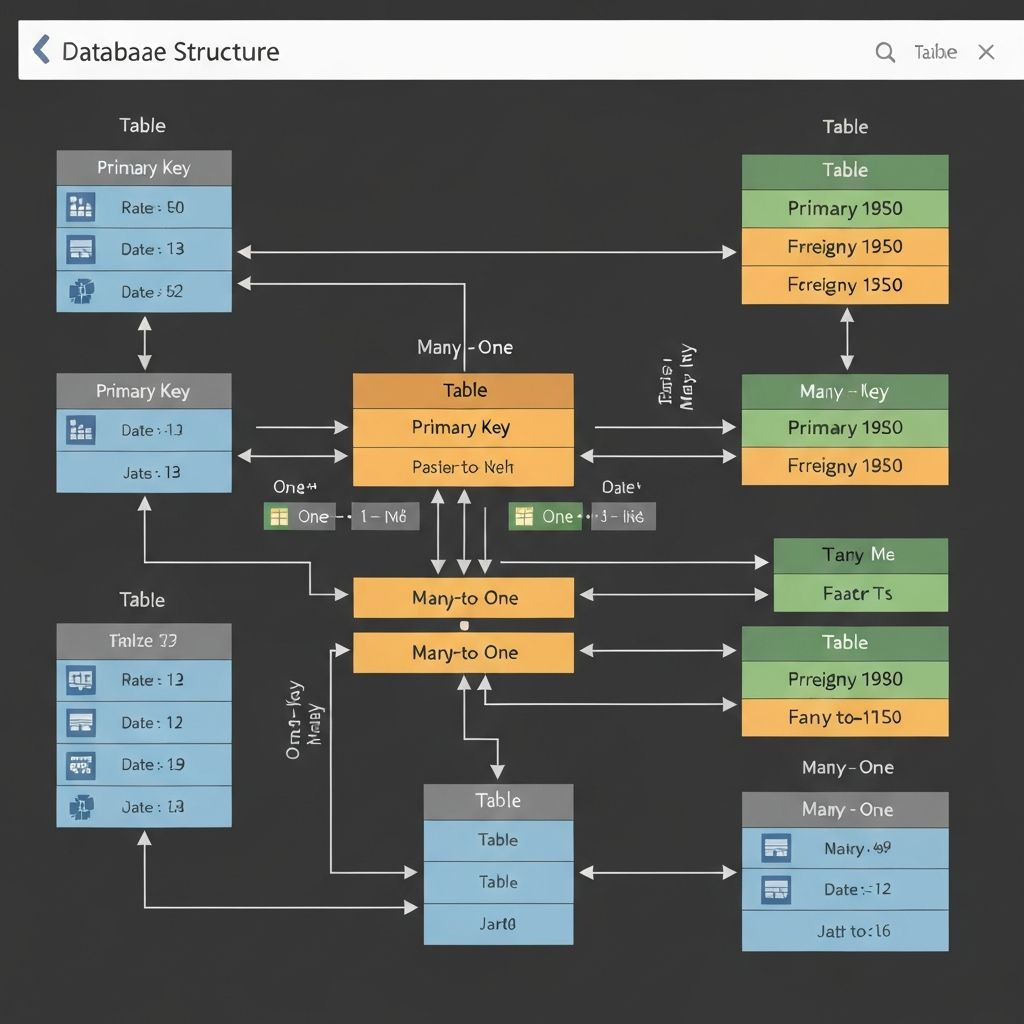
Comprehensive data modeling precedes implementation. Before constructing your Bubble database, systematically map your application's core entities and their relationships through entity-relationship diagramming (ERD). Essential planning questions include:
- Entity Identification: What primary entities (Users, Products, Orders, Projects, etc.) form your application's foundation?
- Relationship Mapping: How do these entities interconnect? Which relationships are one-to-many versus many-to-many?
- Query Pattern Analysis: Which searches will execute most frequently? What filtering and sorting operations are critical?
- Performance Requirements: Which data requires millisecond-level access? What can tolerate slower retrieval?
- Data Volume Projection: What record volumes do you anticipate at 1x, 10x, and 100x user scale?
Option Sets vs. Data Types: Strategic Selection Criteria
Bubble provides two mechanisms for categorical data: Option Sets and custom data types. Option Sets—predefined value lists stored at the application level rather than database level—deliver superior performance for static categorical data.
Use Option Sets for:
- Status values (Active, Pending, Completed, Cancelled)
- Category classifications (Industry, Product Type, Priority Level)
- Fixed dropdown selections (Country, Time Zone, Currency)
- Role-based permissions (Admin, Editor, Viewer)
Use Data Types for:
- Dynamic content requiring frequent additions (Blog Posts, Products)
- Entities with multiple associated fields (Customer records, Project details)
- User-generated content requiring database persistence
- Data requiring individual record-level permissions (Documents, Files)
Relationship Architecture: Best Practices and Performance Implications
One-to-Many Relationships: Optimal Implementation Patterns
Store relationship references on the "many" side of one-to-many relationships. This architectural decision dramatically impacts query performance and data integrity.
Example: In a User-Posts relationship where one User creates many Posts:
- Optimal Approach: Store a "Creator" field (User type) on each Post record
- Suboptimal Approach: Store a list of Posts on the User record
Performance Rationale: Querying "Search for Posts where Creator = Current User" executes significantly faster than retrieving "Current User's Posts" from a potentially thousands-item list field. Additionally, this pattern prevents list field size limitations and enables efficient database indexing.
Need a Database Performance Audit?
Our experts can analyze your current database structure and provide optimization recommendations.
Get Free Database AuditMany-to-Many Relationships: Junction Data Type Pattern
Many-to-many relationships require junction (associative) data types that establish bidirectional connections while maintaining query performance.
Implementation Example: In an educational platform where Students enroll in multiple Courses and Courses contain multiple Students:
- Create Junction Type: "Enrollment" data type
- Junction Fields: Student (User type), Course (Course type), Enrollment Date, Completion Status, Grade
- Query Pattern: "Search for Enrollments where Student = Current User" retrieves all courses efficiently
This architecture enables efficient bidirectional queries, supports additional relationship metadata (enrollment date, progress tracking), and maintains optimal performance at scale.
Performance Optimization Strategies for Production Applications
Search Optimization and Database Indexing Principles
Database search performance degrades logarithmically with record volume. Applications that perform acceptably with 1,000 records may become unusable at 100,000 records without optimization.
Optimization Techniques:
- Constrained Search Scope: Always filter searches by indexed fields (Creation Date, Modified Date, Status)
- Limit Result Sets: Implement pagination with 20-50 items per page rather than loading all results
- Avoid Calculated Fields in Searches: Pre-calculate complex values and store them as dedicated fields
- Leverage "Created By" Indexing: Bubble automatically indexes the Creator field for optimal user-scoped queries
Avoiding Nested Search Anti-Patterns
Nested searches—queries that traverse multiple relationship levels (User's Company's Employees' Projects)—represent a primary performance bottleneck. Each relationship traversal multiplies query complexity and execution time.
Refactoring Strategy: If you frequently need to query third-level relationships, consider denormalizing by storing direct references. For example, if Projects need efficient access to Company information, store a Company field directly on Project records rather than accessing through Project → User → Company navigation.
Privacy Rules and Their Performance Impact
Privacy rules execute on every database query, potentially degrading performance for complex rule sets. Design privacy rules strategically:
- Minimize Conditional Complexity: Simple equality checks (Creator = Current User) execute faster than complex conditional logic
- Role-Based Access Control: Implement role checking through Option Sets rather than complex field comparisons
- Test at Scale: Privacy rules that perform acceptably with 100 records may become prohibitive at 100,000 records
- Consider Alternative Patterns: For complex access control, evaluate workflow-based permissions rather than privacy rule enforcement
Advanced Database Patterns for Complex Applications
Historical Data Management
Applications requiring historical data tracking (pricing changes, status transitions, audit trails) need specialized architectural approaches:
- Snapshot Pattern: Create timestamped snapshot records capturing state at specific moments
- Event Sourcing: Store all state changes as events, reconstructing current state through event replay
- Versioning: Maintain version numbers and archive previous versions in separate data types
Soft Deletion Architecture
Rather than permanently deleting records, implement soft deletion through "Deleted" boolean fields. This approach:
- Enables data recovery and audit compliance
- Maintains referential integrity for related records
- Supports "undo" functionality in user interfaces
- Preserves historical analytics and reporting accuracy
Common Database Design Anti-Patterns to Avoid
- List Field Overuse: Storing complex objects in lists rather than establishing proper relationships
- Excessive Data Type Fragmentation: Creating separate data types for entities that should be unified with categorization fields
- Premature Optimization: Over-engineering database structure before understanding actual usage patterns
- Ignoring Backup Relationships: Failing to maintain bidirectional navigation paths when beneficial
"90% of Bubble application performance issues stem from suboptimal database architecture. Invest time in proper data modeling upfront to avoid expensive refactoring later." — BubbleXperts Team
Build a Scalable Database from Day One
Our database architecture specialists have designed data models for applications serving millions of users.
Get Expert Database DesignExpert Database Design Services
At BubbleXperts, we provide comprehensive database architecture services including ERD development, performance auditing, migration planning, and optimization consulting. Our team has architected databases for applications processing millions of transactions daily while maintaining sub-second query performance.
Contact us to discuss your database architecture requirements and scalability objectives.
Ready to Build Your Bubble Application?
Let's discuss how we can help you create a powerful, scalable application with Bubble.io. Schedule a free consultation with our experts.